Throughout the late-1970s, Britain was ridden with political instability, social unrest and economic insecurity. Unemployment stood at 1.6 million; rubbish piled up on streets; strike action debilitated the country, and blackouts became a common feature across everyday life. In the towers of political power, James Callaghan's Labour government was failing, and Margaret Thatcher was desperate to become Prime Minister.
Subsequently, the Conservative Party employed the communications and advertising agency Saatchi & Saatchi to create a series of campaigns for them. Founded by brothers Charles and Maurice Saatchi in 1970, their agency believed that advertising could sell anything. Politics soon become the latest ensemble in this conviction.
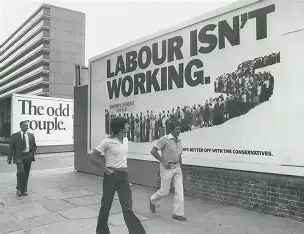
In 1978, Saatchi & Saatchi produced an image showcasing a myriad queue of people waiting at the unemployment office. Above, in block letters, was written 'LABOUR ISN'T WORKING'. It was a simple message, accompanied by a simple double entendre.

However, like most things of immense significance, the poster wasn’t without an initial round of doubts. Mrs. Thatcher’s reaction was one of hostility, stating:
"No! You know perfectly well that you should never have the other side's name in your own poster!"
Charles Saatchi, too, was sceptical of whether or not his agency’s work would resonate with voters.
In time they were proved wrong: it became the talk of television, newspaper and radio stations across Britain. Things truly ignited when the then-Chancellor Dennis Healey delivered an impassioned denunciation of the poster in the House of Commons, describing it as “selling politics like soap powder”. His words gave the Conservatives all the publicity they needed.
The following year Saatchi & Saatchi’s poster was reissued for the general election; it now read: 'Labour Still Isn't Working'. Well, it became evident that Labour would no longer be in work after the election, with the Conservatives forming a parliamentary majority off sixty-two seats. Party treasurer Lord Thorneycroft attributed the Conservatives’ success to the poster, and it tarnished the public’s perception of the Labour Party for at least a generation.
What’s more, Mr. Healey wasn’t wrong in his assessment of the image either. The crowd depicted on Saatchi & Saatchi’s poster were not unemployed workers, waiting for the dole. They were, in fact, a group of twenty-odd volunteers from the Hendon Conservatives who coalesced in a park in North London. Art director Martyn Walsh laid out a long length of rope in a snake-like shape and photographed the volunteers at different points along it. The images were then stripped together to form a seemingly endless queue dense with blurred faces. In a pre-digital age, it was a laborious act of fabrication. One which worked to a tee.
In the echelons of political communication, the legacy of Saatchi & Saatchi’s poster was immense. They had inaugurated a new form of British electioneering, one centred on ‘negative campaigning’. The approach was simple: rather than highlighting what your party offered, you would attack your opponents for their faults instead. The mantra of the best offence being a good defence was spun on its head. The context behind the poster also reveals an innate logic behind negative campaigning: the creation of narrative. Under this regime of politicking, the new truth is that the truth should never get in the way of a good story.
Over the years Saatchi and Saatchi’s poster have inevitably been reproduced.
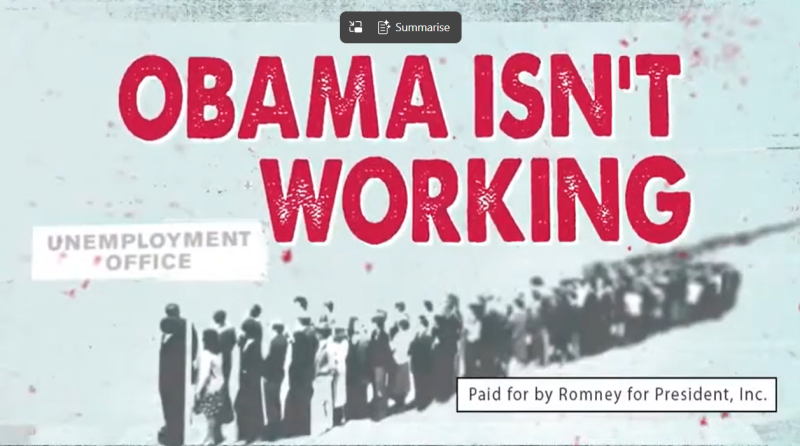
But I find its influence lies deeper, in more diffused ways.
In today’s political climate defined by polarisation, it’s hard to not see the legacy of negative campaigning.
Consider, for instance, Reform’s placards during the local elections: “Vote Reform. Get Starmer Out”. This is negative campaigning distilled to its purest form. What’s on offer isn’t policy, nor a vision, but a pure expression of opposition. Carl Schmitt split politics between friend and enemy – it is not what you stand for, but what you stand against. Here, Reform’s electoral strategy is undeniably Schmittian: you’re not voting for Farage, you’re voting against Starmer and all he embodies.
And of course, Labour isn’t puritan, either. Starmer’s own approach has been to incessantly defer to the convenience of Conservative mismanagement when justifying his administration’s current failures. Whilst there is credibility to this, two-years have begun to make people feel, rightly, impatient. As for Farage, Starmer’s only retort is to brand him as a snake oil man looking to pull the wool over the electorate’s eyes. Meanwhile, it seems the one thing Labour and Reform find consensus on is in their determination to cast the Greens as an unserious entity, a fringe of drug-addled student politicians unfit for the responsibilities of power.
The list goes on, the principle is the same: attack, attack, attack.
Advocates of negative campaigning defend it on the grounds of realpolitik -an unsentimental pursuit of power requires unsentimental means. In today’s media landscape characterised by fluidity, speed and outrage, it’s hard not to see the appeal behind this cynical, instrumental strategy.
For its detractors, on the contrary, they lament over the olden days whence liberal norms and ideals of ideas over identity, and argument over enmity, took precedence. For them, a voter has to be persuaded, not provoked.
Yet, regardless of one's political conviction it seems only one means of communication is employed today. The tactic recognition that the pursuit of power oft requires any means necessary, has the stamp of Saatchi & Saatchi engrained within it.
Add comment
Comments