
I want to explain this International Relations (IR) theory I studied during my master’s course called “uneven and combined development” (U&CD). I’m infatuated with its holistic, yet polymorphic, way of examining the world; it’s completely reaffirmed to me the importance of relativism when analysing phenomena. U&CD doesn’t have a rich history in IR debate. But, as the story of the 21st century – the perceived ascendance of China on the world stage – plays out, U&CD will only grow in relevance. So, if you want to learn a sleek, emerging postgraduate theory without the masquerade of dense academic jargon so impress your friends by being knowledgeable about international politics, follow on.
A Long Time Issue
A simple question: how can we combine international and national dynamics into a convincing theory which explains global development? Perhaps it seems easy. Perhaps the answer lingers on the tip of your tongue. Well, for a long-time people more qualified than me struggled with this question. The founders of social science – Weber, Marx & Durkheim – couldn’t answer it. Nor could Kenneth Waltz, one of IR’s most influential scholars, who once confessed quite candidly:
“Nobody’s thought of how to do it. I’ve thought about that a lot. I can’t figure out how. Neither can anybody else so far”. Subsequently, Waltz’ belief in “realist theory” – an ‘anarchic’ world stage divided between great powers – became the benchmark for understanding global politics in International Relations. Realist analysis was inclined to examine developmental phenomena through internal, nation-state frameworks as opposed to a bigger, internationalist picture. But then comes Justin Rosenberg. And Rosenberg wants to challenge this idea.
Admittedly, he doesn’t have to do too much from the get-go. He just looks at what’s been overlooked. So, Rosenberg looks to Leon Trotsky. More specifically, Trotsky’s three-volume epic The History of the Russian Revolution. Rosenberg doesn’t have to read far, either, because it’s in Chapter I where Trotsky discusses the peculiar character of Russia’s historical development in a rather peculiar way. So, Rosenberg looks to this brief insight and turns into a wider theoretical framework, one which can explain the past, present and future of the world. Impressive.
Uneven and Combined Development
How?
First, Rosenberg stakes some basic claims. Look to society. There have always been independent societies. What’s more, they have always existed among other, independent societies. Now consider development. For all its variations, the one thing any form of development has is in common is that it’s inherently uneven. If this can apply to biology, the natural sciences, it can apply to societies, or what I’ll now call countries, too. Just think to all the varying population-sizes, geographies, economies, militaries differing between countries. Some are bigger, more developed (especially materially), than others.
Because countries are inherently uneven, the undeveloped want to develop and catch up – we’re going to use some of Trotsky’s terminology and historical examples here, but I’ll clear things up the best I can. Here we have the first stage of U&CD. This is A) “the whip of external necessity”. Imagine: it’s 1760 and the neighbour you don’t like, Great Britain, has become the first industrialised country in the world. You’re not only going to feel immense jealously toward Britain, but insecure of its power as well. You need this thing your neighbour Britain has, otherwise you don’t feel safe. This external event completely out of your control has ‘whipped’ you into action.
Thankfully, this isn’t too hard because you can just imitate the thing you want. Your B) “privilege of historical backwardness” means you can sidestep the long, arduous process of figuring out how Britain industrialised and just import the pre-existing ideas and industry into your country instead. However, here’s where the crux lies. You’ve also got to consider the consequence of importing this pre-existing thing from a different country into your own, very different country. Development is not a linear process, and can cause all sorts of consequences, good and bad. This is the last, and most important, step, C) “the law of combined development”. This three-part process reminds me of one of my favourite maxims: “Once something has been done, it will be done again – but never the same way twice”.
The Uneven and Combined Development of 19th century Germany
Let’s consider another example. This is taken from Dr. Jeremy Green’s essay, which is linked below.
Germany in the 19th century was a spectacular example of U&CD which saw its whip and privilege of historical backwardness surpass Britain as an industrial power, but with a law of combined development carrying immense consequences in its wake. Why is this?
British industrialisation coincided with its global dominance, Pax Brittania. Whilst developing industry was incredibly arduous for British workers, Britain managed to quell any serious radicalism. This can be attributed to the failure of the Chartists in the 1850s, the passing of various worker reform acts and the founding of the Labour Party in 1907 as an organisation dedicated to parliamentary democracy.
Meanwhile, Germany imported British industry whilst retaining much of its old-world, feudal apparatus. Changes in Germany’s socioeconomic structure came as harsh ruptures. Unlike Britain, the German state intervened throughout the process of industrialisation, and tension grew.
German workers viewed their state with much more antagonism compared to the British, who became accustomed to liberal democratic ideals and parliamentarianism. In Germany, this led to an uneasy alliance between a conservative state, the Junkers (old elites) and industrialists (new elites) against the workers, led by the SPD.
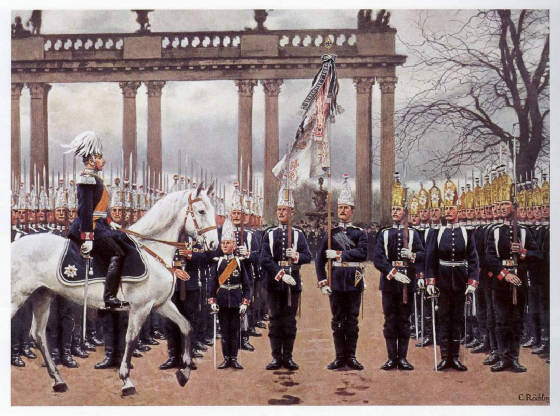
To avoid any uncomfortable questions regarding wealth redistribution, the Junkers and industrialists aroused ultranationalist sentiment as a distraction instead. Unique to Germany at this time was “the national question” relating to what areas or people counted as ‘German’. This was an important consideration considering the fractured lands would only unify in 1871 under the mantle of Imperial Germany.
What’s more, Imperial Germany looked to British Social Imperialist ideals like free-trade and indirect colonialism for inspiration. This itself represented another instance of U&CD. The state-Junker-industrialist pact was whipped into this course of action by refusing to change the unequal structure of German society, and their privilege of historical backwardness was provided to them by British colonial ideals. One aspect of the law of combined development manifested in the unique character of German social imperialism, but another aspect held graver repercussions.
Global economic downturn and worsening international conditions across the 1870s made the German elite’s goal of social imperialism untenable. As a result, the Junkers and industrialists lobbied the state to enact trade protectionism, outright colonialism and militarisation to further undermine left-wing hostility under a banner of ultranationalism. By extension, what was known as Weltpolitik (aggressive expansion) replaced Realpolitik (pragmatism and diplomacy) in German foreign policy by the century’s close.
And so, Germany became increasingly aggressive on the world stage, colonising modern-day Tanzania, Rwanda, Cameroon and Togo, among others, whilst expanded its navy in the hopes of rivalling Britain. By 1882 Germany signed a ‘triple alliance’ with Austria-Hungary and Italy pledging ‘all for one and one for all’ in the case of war. Fast forward to 1906 and tensions between the ambitious Imperial Germany and a defensive British Empire were reaching a loggerhead. All it took was Archduke Franz Ferdinand of Austria’s assassination on the 28th of June 1914 to spark things off.
Overall, Green’s U&CD analysis provides a holistic analysis toward the First World War’s causes by considering the distinct character of German industrialisation. By comparison, the Sonderweg Thesis, which for a long time remained the conventional understanding for the war’s cause, argued that Germany strayed from a ‘linear’ path of development – Britain being ‘the norm’. As we now know, this isn’t true because development is always uneven and relative to all the different variables which define a country.
So, to reassert some points:
- Independent societies have always existed
- Independent societies have always existed alongside other, independent societies
- Development is always uneven
Considering this, the three steps of uneven and combined development are:
- A) The whip of external necessity: something spurs you to action, you must react to keep up
- B) The privilege of historical backwardness: you can copy the thing you want
- C) The law of combined development: the consequence of importing an external thing into an internal country; once something has been done, it will be done again – but never the same way twice.
In a diagram, U&CD would look like this:

Conclusion
U&CD will only grow in relevance this century. I think it's long overdue. I have applied it as a theoretical model to others essays; I may post them here. I also have others ideas, which I may write about. Let's see.
Add comment
Comments